
Long read · Distribution · Returns and warranty · Margins · Automation
The reverse supply chain: why returns and warranty claims are where distribution margins leak
At a 4% margin, every lost dollar takes $25 of new sales to replace. Ben Firman of Continuum on why returns and warranty are a distributor's most expensive transactions.
AI Reality Check · · 10 min read
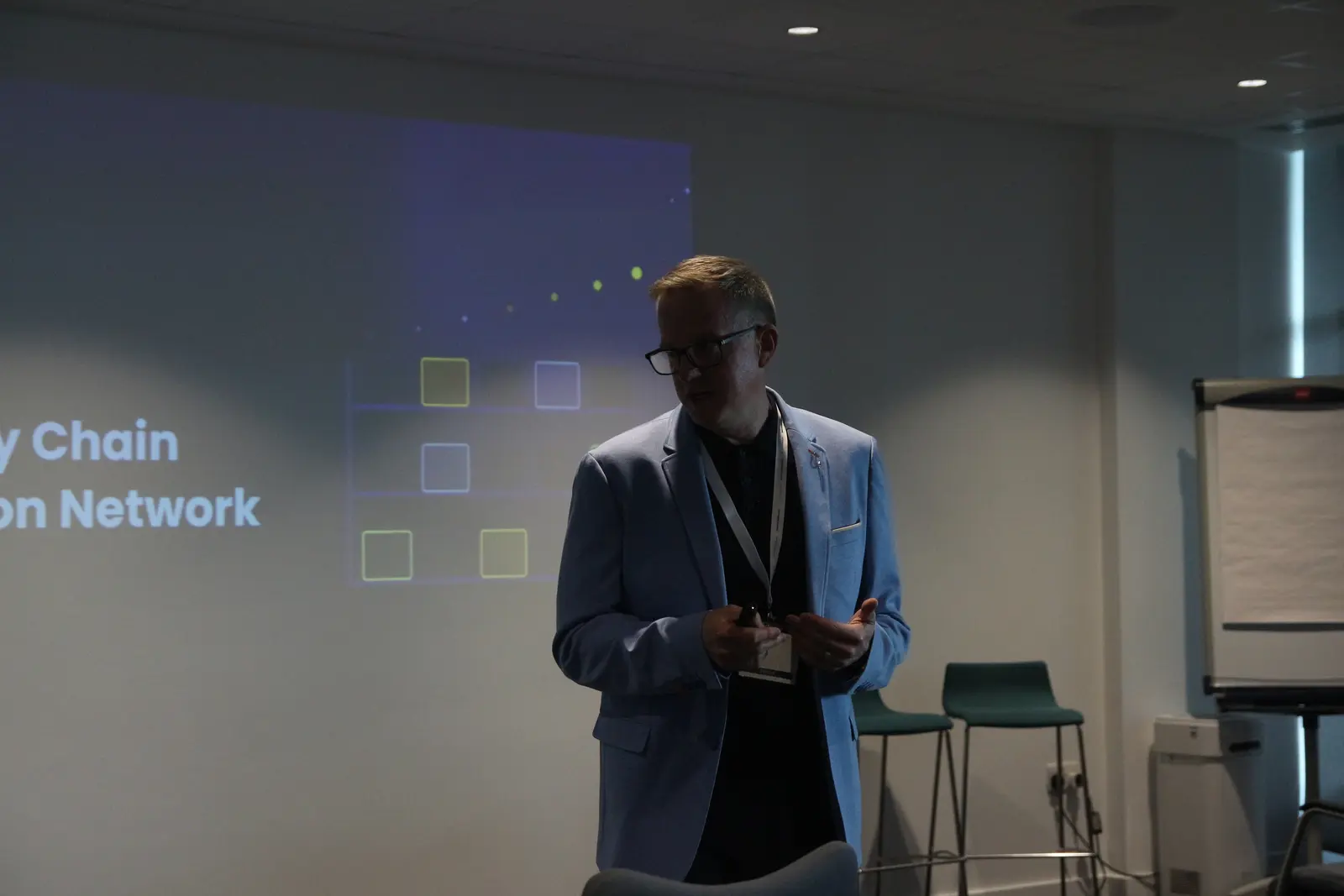
Here is the sentence that frames this whole essay, and it comes from a slide: "Every $1 lost takes $25 of new sales to replace." It is not a rhetorical flourish. It is arithmetic. If the average wholesale distributor keeps about four cents of operating profit on each dollar it sells, then every dollar that leaks out of the business has to be won back by selling twenty-five more.
Ben Firman, Vice President of Sales at Continuum, built the case-study session at AI Reality Check around that arithmetic. Ben began in the UK supply chain and has spent eleven years leading go-to-market teams at US technology vendors serving North American distributors and manufacturers, and now leads go-to-market at Continuum, a supply chain transaction network. The session, "The Supply Chain Transaction Network", was held at the Manufacturing Technology Centre in Coventry on 15 October 2026. Its subject was not AI in the abstract, but one of the least glamorous and most expensive places to apply it: the work that comes back through the door.
Two squeezes that adding people cannot fix
The session opens on a pair of pressures under the heading "Fewer people. Thinner margins."
The first is skilled labour. The people who understand the supply chain, the slide says, "are leaving faster than they can be replaced". It cites a 2024 study by Deloitte and The Manufacturing Institute: 3.8 million jobs to fill by 2033, of which 1.9 million, one in two, may go unfilled. The second is margin: the average operating margin across wholesale distribution is 4%, which the slide renders as "96 cents of every dollar is already spent". There is, in its words, "no room left in the business to absorb inefficiency."
Its conclusion is four words: "Neither problem is solved by adding people." You cannot hire your way out of a labour shortage, and in a 4% business each extra head has to be paid for out of a margin that has nothing spare. If the work is going to be done with fewer people, the work itself has to change.
One transaction is never one transaction
The second slide is the one operators tend to recognise at once. It follows what happens when a transaction arrives, whether a customer purchase order, a quote, a return authorisation or a warranty claim. It is captured, validated and written into the ERP. Then it starts to multiply: "Every transaction cascades into more transactions."
A sales order produces a pick ticket for the warehouse and, if the item is not on the shelf, a vendor purchase order for purchasing. Those lead to a packing list and bill of lading, to an order acknowledgement and an advance shipping notice, to a receipt. Finance then runs a three-way match across order, receipt and invoice, receives the vendor's invoice, and issues the customer's. A customer return adds its own branch, through customer service. The slide marks every point at which the work passes from one team and one system to another, and it names what happens at each one: "Every handoff costs labor, leaks money, and hurts customer experience."
The useful thing about this picture is that it explains why growth does not make processes cheaper. Each handoff is a place where information is re-keyed, interpreted, delayed or lost, and a business with more transactions simply has more of them. Which brings the session to the transaction that cascades furthest.
What comes back
What comes back hits the P&L harder than what goes out.
A sale is a rehearsed process: the product, the price and the customer are known. A return or a warranty claim is an exception to all three. The slide traces how many people touch one. It can start at the trade counter, by email, by phone, with a driver or with field sales. It then moves through returns and warranty admin, receiving, inspection, procurement and finance, before the last step, which belongs to someone outside the building: "The vendor decides", approving or denying the claim and issuing credits. "Every return & warranty is a multi-department project," the slide says.
The cost is quantified per transaction. A stock return into inventory costs $33 in labour. A vendor return or warranty claim costs $175. That is more than five times as much, for work that earns nothing.
Four ways the money leaks
The session lists where the loss actually occurs, and it is worth reading as four separate failures, because each has a different cause.
- Returns accepted that should not have been. Accepted at the counter before coverage, eligibility and time windows have been checked.
- Restocking fees missed. Fees the distributor is entitled to charge and does not.
- Inventory write-offs of 1 to 2% a year. Stock that was bought and never sold, and stock that came back and cannot be resold.
- Missed vendor credits. Credits that were given and then denied, and a further 5 to 10% that were approved but never collected.
The slide adds a fifth, which is not on the balance sheet but explains the first: "Protect the P&L or protect the relationship." Standing at a counter with a contractor waiting, the choice is not close. The relationship wins, and leakage becomes the practice.
What that means in money
The following is our arithmetic, not the session's, and it is an illustration. The case-study distributor, described below, has about $35 million in annual revenue. Suppose a leak of just 1% of revenue, $350,000, across missed credits and avoidable write-offs. At the industry-average 4% margin from the slide, replacing that $350,000 would take about $8.75 million in new sales. The same exercise on your own numbers is a good way to decide whether this is the project that deserves attention.
Why the vendor side is the hard part
There is a structural reason claims leak that the session circles without stating it as a theory. A distributor does not file claims with one counterparty. It files them with every manufacturer it buys from, and each has its own forms, rules and channels: the session lists vendor portals, email, EDI and API. Capturing a claim "to each vendor's specification" at the counter is a different task for every manufacturer, and multiplied across many distributors and many manufacturers it is a many-to-many problem.
The network answer is to connect each party once. On Continuum's network both sides work from "one shared transaction record", and "updates land live on both sides". In our reading, that is a design choice with a clear consequence: the distributor does not need a custom integration with each manufacturer, and the manufacturer does not need one with each distributor. The scale reported in the session is the point of the design: 150 distributors on the platform, more than 80 of them HVAC, filing into more than 600 manufacturers, and two OEMs using Continuum directly.
What one distributor did
The session's case is R&E Supply, an independent HVAC distributor in Little Rock, Arkansas, with about $35 million in revenue, about $12 million of inventory, 70 employees and 8 locations. It introduced AI into its operation around twelve months before the session. The slide describes how: some tools were bought, others built.
The bought list is the mission-critical systems and the tools where a network or a specialist matters: an Epicor ERP, moving to the cloud within 18 months; Lantern for AI demand forecasting; Moblico for texting and order automation; and Continuum for warranty automation. The built-in-house list, made "with AI", is smaller, internal and specific to the company: store task lists with an audit trail, a vehicle and asset manager, PDF scraping into document archiving, customer stratification and dashboards, and an internal IT ticketing system.
The pattern is useful on its own. The things that touch other companies, or that need data from many of them, were bought. The things only R&E cares about, the long tail of small internal tools that used to wait for a developer, were built quickly with AI. The slide's quote from the company's CEO, Jonathan Pope, sets the attitude: "We could choose for AI to be either the great equalizer of competition or the great tidal wave that wipes us out. We chose to lean in. We do not fear the future – instead, we look forward to it."
What changes at the counter
The session describes the claim as "one controlled system" from initiation to credit reconciliation, and it is easiest to follow in order.
Initiation. The customer, a contractor in the field, starts the claim from the jobsite: the coverage, the part and the claim, captured to the vendor's specification. For returns, an RMA is created and the distributor's own rules are applied, including restocking fees. Status and credit are visible without chasing.
Receiving. Check-in is fast, with QR scanning and automatic bin assignment. Returns are job-based, so one job can be split correctly. A guided inspection captures structured data rather than a note.
To the vendor. The claim is filed with the manufacturer by whatever route the manufacturer uses. If more information is needed, the distributor is notified in the portal. Credits are matched against what was claimed, and a short credit is escalated.
The session reports what this did, in the presenter's figures. A counter claim takes one to three minutes, not 20 to 30. Contractors file in minutes from the jobsite. Warranty administration at the distributor falls close to zero, with no missed vendor credits. Manufacturers receive clean claims and accurate defect data, only accurate claims are approved, and the slide counts less fraud among the gains. The network itself went from its first warranty customer going live in April 2025 to the scale above in 18 months.
From claims to inventory
The last section applies the same logic to the stock that never moves. "Go beyond knowing what will sell. Act on what won't." The framework has three steps: identify the excess, decide the recovery path, act.
Identification combines the demand forecast with vendor terms. The sources are stock that was bought and not sold, stock that came back and cannot be resold, and stock that is long at one branch and short at another. The decision checks eligibility and the return window, weighs freight and restocking fees, and picks the route that recovers the most. The action can be a transfer to another branch, with no vendor involved and no restocking fee; a return raised and filed in the vendor's portal; a listing, anonymously, to other distributors on the network; or simply a hold, because the forecast says to keep it. Incoming returns can even be routed to the branch where the forecast says the stock will sell.
Questions worth asking about your own returns
These are ours, not the session's. They are designed to be answered from data a distributor already has.
- Where do claims enter, and how many systems touch each one? A claim that is re-keyed three times is a claim that will be wrong once.
- What share of eligible claims reach the vendor at all? The missing ones are the first leak.
- Of the credits approved, what share is collected, and how long does it take? The slide's range, 5 to 10% approved but never collected, is a benchmark for how large the gap can be.
- What does a claim cost in minutes, not dollars? Counter time, admin time, receiving time and finance time, added up.
- How much of write-off is stock that was bought wrongly, and how much is stock that came back? They need different fixes.
- Who decides at the counter when policy and relationship collide, and with what information?
The case for starting here is the one the session makes in its first minute. A business with a 4% margin and a shrinking pool of skilled people does not have room for a process that costs five times as much as the one next to it and loses money at four different points. It is also one of the places where the improvement can be measured, in minutes and in credits, before anyone argues about AI.
Figures and quotations are from Ben Firman's session and the Continuum material presented at AI Reality Check (more at gocontinuum.ai); the arithmetic and the questions are ours. More from the day: the event recap, photos and video and Ben's profile. Our next session is an online webinar on 26 November: join the list.