
Long read · Supply chain · Resilience · Decision-making · AI strategy
Why resilience is the wrong goal for supply chains in the age of AI
Sean Culey's argument from the opening session of AI Reality Check: disruption is cyclical, resilience only returns you to fragility, and AI is limited by how an organisation decides and thinks.
AI Reality Check · · 14 min read
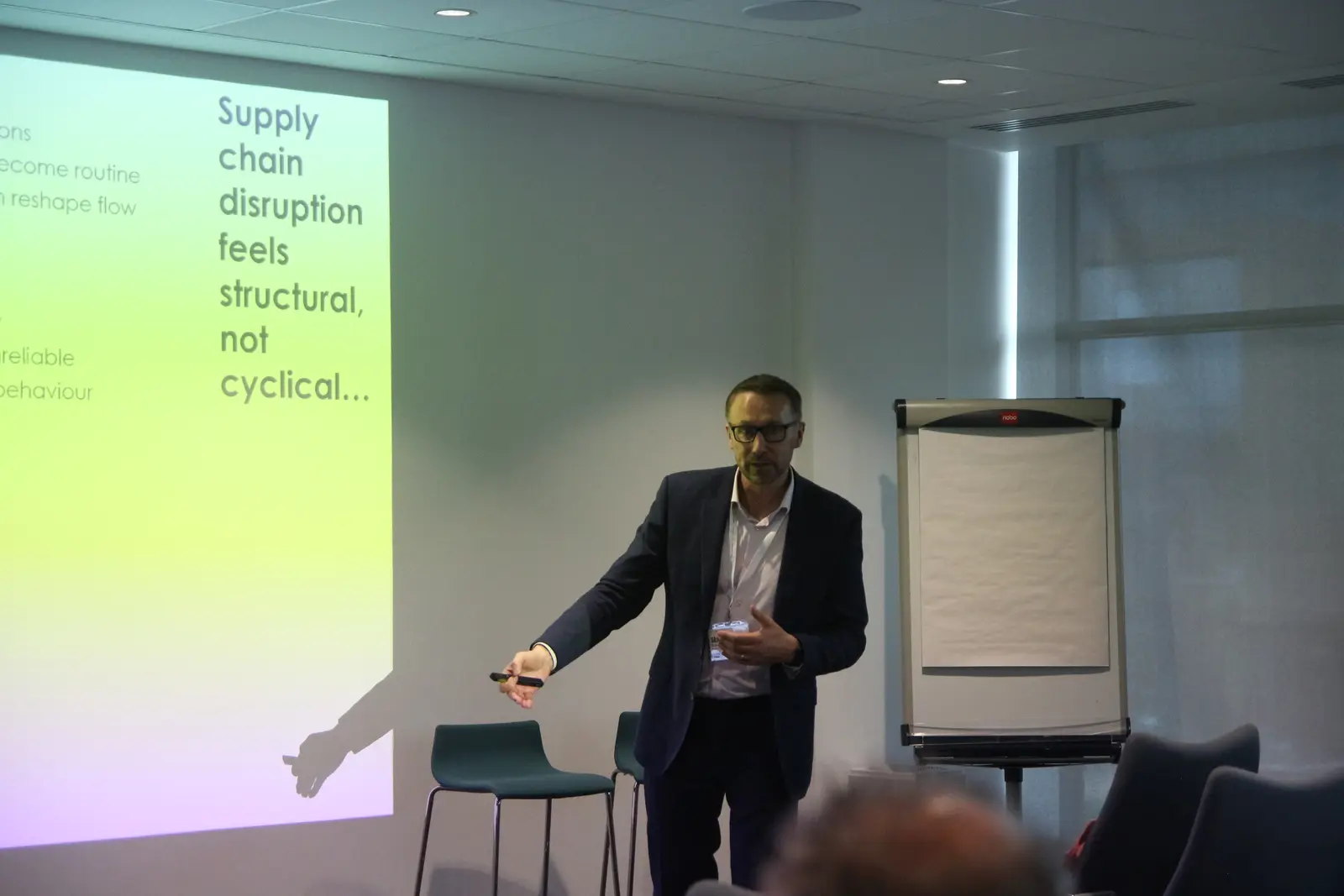
Ask a supply chain leader what they want from the next five years and the answer is usually one word: resilience. Hold more stock, dual-source the critical parts, shorten the network, build a control tower. It is a sensible reaction to a decade in which the black swan became a quarterly event. It is also, according to Sean Culey, the wrong goal.
Sean is Director of Supply Chain at the Manufacturing Technology Centre, a Visiting Fellow at Cranfield School of Management, a Fellow of the Chartered Institute of Logistics and Transport, and the author of Transition Point: From Steam to the Singularity. Sean opened AI Reality Check at the MTC in Coventry on 15 October 2026 with a session called "Beyond Resilience: Learning to Thrive in Disruptive Times". This essay follows its argument, adds background where it helps, and ends with a way to put it to work on Monday morning.
The feeling that it never settles
Sean starts with a diagnosis that most people in distribution and manufacturing will recognise. Several forces are converging at once. Networks are contracting: supply chains are getting shorter, corridors matter, and network redesign favours resilient hubs over pure cost optimisation. Costs are under persistent pressure in Europe, from energy volatility to road pricing, regulatory burden and weak growth. And automation is accelerating, with AI, robotics and data visibility becoming mainstream faster than expected while skilled labour remains scarce.
The session's name for the result is hyper-fragility, and it breaks down into four things that make decisions harder. Change is rapid: "Black swan events have become routine." The future is unpredictable: "Forecasts degrade quickly." There are many variables, so that "small disturbances" have "outsized impacts". And situations are unclear: "Drowning in data, starved for meaning." Put those together and, Sean says, supply chain disruption starts to feel "structural, not cyclical".
Then comes the turn that defines the rest of the talk: "So, are we doomed? No. Because it is cyclical. We've been here before. Five times in fact."
Why the answer is no: the long waves
The idea that technology moves in long waves goes back to the Russian economist Nikolai Kondratiev, whom the session quotes from 1926 on the turbulence of the rise: "It is during the period of the rise of the long waves, i.e., during the period of high tension in the expansion of economic forces, that, as a rule, the most disastrous and extensive wars and revolutions occur." Sean's frame is the modern version of that idea by the economist Carlota Perez, in which each wave of innovation, lasting roughly 40 to 50 years, has two phases.
In the first, installation, new inventions materialise and we "use new tools to do old things in new ways". The focus is efficiency. Money from financial capital rushes in, income polarises, a bubble builds and bursts. After a turning point comes the second phase, deployment, in which inventions turn into innovations that become industrialised. Now the tools are used to do "entirely new things", production capital leads, innovation spreads across the economy and a golden age emerges. The session shows the pattern twice. James Watt's steam engine was built to pump water out of coal mines; it took Stephenson's Rocket for the same technology to power a new way to move people and goods. The Benz Patent Motorwagen was the first production car with an internal combustion engine; the Model T of 1908 was mass-produced personal transport.
Sean's claim is that we are in the same place in the sixth wave, the digital one: past the installation phase of the digital age, in a turbulent transition, and "fast approaching the second phase". History says what usually follows. The session lists the golden ages of canals and industry, of rail and steam, of the Victorian era, of the automobile in the Roaring Twenties and of telecoms and computing after the Second World War, and then names the one we are heading for: "Golden Age of AI, Robotics and Autonomy".
Why we keep getting the timing wrong
A second idea explains why this is hard to feel from the inside. Amara's Law, which the session quotes, says: "We tend to over-estimate the impact of technology in the short-term, and under-estimate it in the long-term." The deck's chart shows the first phase as deceptive, with hype running ahead of results, and the second as disruptive, with change arriving faster than anyone planned for. Two photographs of Fifth Avenue in New York carry the point about speed: in 1908 there are no cars; in 1913 there are almost no horses.
The session's list of technologies that fell foul of Amara's Law in phase one, but that it expects to be revolutionary in phase two, is a useful reminder of how much disappointment sits in the early years: blockchain, vertical farming, autonomous vehicles, hyperloop, additive manufacturing and robotics. For supply chains, the part that matters is what phase two brings: an "automation triple whammy". Horizontal convergence, the move from muscle to machine, automates physical tasks. Vertical convergence, from mind to machine, automates knowledge-based tasks. Technological convergence, from machine to machine, automates the end-to-end supply chain. And the warning that goes with it: "Phase Two industrial innovations are going to be transformative – but only for those able to create value from them."
Fragile, resilient, anti-fragile
If the disruption is not going away, the question is what kind of organisation does well in it. Here the session borrows the vocabulary of anti-fragility, a term popularised by Nassim Nicholas Taleb for things that do not merely survive stress but get better because of it, and applies it to companies with an observation from Sean: "Every organisation is perfectly designed to get the result it gets."
A fragile organisation is built of narrow specialists in narrow functions, 'I-shaped' people with a span of control that stops at their department. Its focus is efficiency and its objective is to react to problems; it hates uncertainty, and disruption leaves it with something like post-traumatic stress. A resilient organisation has 'T-shaped' people in supply chain teams that work across the chain. Its focus is effectiveness and flow, it manages uncertainty, and it survives. An anti-fragile organisation has 'X-shaped' people in value networks that stretch across business models. It focuses on creating more value for customers and stakeholders, it loves uncertainty, and the result is "post-traumatic growth".
The three are given physical metaphors that are worth remembering. Fragile companies behave like non-Newtonian fluids: fine under normal conditions, but under pressure they lose their shape, stop flowing and become stiff. Resilient companies are like da Vinci bridges, whose components work together under load to hold the structure in place. Anti-fragile companies operate like muscular systems: the body works together to take the force, adapts and learns, and needs more stress next time to have the same effect.
The question is not how to protect today's business from tomorrow's shocks. The question is how to build an operation that gets stronger as the environment becomes more demanding.
That is why the session treats resilience as a waypoint and not a destination. "Resilience-only strategies simply return organisations to fragility after each shock. This is surviving, not thriving." A buffer of stock or a second supplier is worth having, but it leaves the organisation exactly as it was, ready for the next disruption to find the same weakness.
The same split applies to AI
Sean applies the same three-way split to how companies use AI. In the fragile version, AI is aimed at "human elimination and process automation": cost savings and headcount reductions, AI as a tool to survive. In the resilient version it is used for efficiency and optimisation, to find waste and keep up with competitors: a tool to improve. In the anti-fragile version it is used for human enhancement and differentiation, "to create radically new ways of working, new revenue generating ideas" and new value: a tool to innovate, even to 10x.
Most companies, Sean argues, are only asking whether AI can automate things people already do. Amara's Law shows why that is not enough: real innovation "happens not when technology is used to do existing things more efficiently, but when it is used to achieve things that were previously impossible". Two lines on the slide make the point. "The lightbulb wasn't created from continuous improvements to the candle." "The motorcar didn't emerge because of projects to improve the horse." The best question to ask about AI isn't "what can we automate?", the session says, but "what if". There is also a competitive logic to it: "If everyone has access to the same AI systems, where is the competitive advantage?"
From data-driven to decision-driven
The second of the session's three principles is about decisions. It begins with an uncomfortable observation about the last decade of digital investment: "Some automation, but little transformation." The session cites a Gartner view, from Dwight Klappich, that more than 60% of companies surveyed plan to invest in intelligent automation, while an equal share say they are not organisationally prepared to adopt it. Most "transformation" projects, it argues, digitise existing inefficient processes instead of changing how the business operates, and they can succeed on their own terms while failing strategically. A project can be on time, on budget and in scope, which answers "Did we deliver the thing?", and still not answer "Did anything get better?" In the session's words: "Green project dashboards can still create red strategic outcomes."
More data, harder decisions
Data was supposed to be the cure. The session cites a 2021 survey by Signal of 1,000 C-suite leaders at organisations with more than 500 employees: 80% feel they have too much data to consider when making decisions. Two-thirds say decision-making is only somewhat or rarely data-driven. 58% of companies base half of their decisions on gut feel, and 53% cherry-pick a data point to make the case. Sean's summary is memorable: data is used "in the same way a drunk uses a lamppost – for support, not illumination". Many companies are data rich and insights poor, with a data lake that has turned into a data swamp, and a further statistic on the slide, that 79% of data science effort goes on collecting, organising and cleaning data, explains why.
The proposed answer is to turn the question around. Instead of mining existing data for insights and hoping they are useful, start with the outcomes the business needs, ask which decisions will get it there, and only then ask what data, analytics, expertise and models could improve those decisions. The question for every leader, the session says, "is not 'do you have enough data?'", because you almost certainly do. It is whether the organisation has a decision architecture that can turn that data into choices that compound over time.
Measure decision quality, not data quality.
Sean adds that this does not need AI to begin, and gives a list of questions that works as a self-assessment. What is the desired strategy and outcome, and do you know? What decisions lead to it, and who makes them? What do good decisions look like? What data would you need to make the best decision possible? What trade-offs are likely, and which of them are good ones? What actions do those decisions lead to? "Data quality is a means. Decision quality is the outcome."
The ladder to a self-driving supply chain
Once decisions are the unit of analysis, AI can be placed on a ladder. At level one, descriptive diagnosis, machines give humans data and root-cause analysis of current issues: decision support, with humans in the loop. Level two adds predictive insights. At level three, prescriptive proposals, humans decide using recommendations from machines: decision augmentation, with humans on the loop. At level four, the self-driving supply chain, machines make decisions, act autonomously and learn from experience: decision automation, with humans out of the loop, which is where agentic AI points.
The session describes the working model as a loop of five verbs: sense, analyse, decide, act, learn. An agent notices an external change, such as a commodity price rise, a tariff, bad weather, geopolitical unrest or trouble at a key supplier, and recommends or takes action: re-prioritise fulfilment, stockpile raw materials, consolidate shipments, switch supplier, reschedule production. The claim for decision intelligence is a change in the clock speed: recommendations reviewed in under a minute, or under a second if automated, against a much longer cycle with traditional analytics. Trust is the hinge. "To trust the agent's recommendations, people will need to understand how they arrived at them… For now." And the direction of travel is clear: once we trust the agents, we will pass decisions to them, and the result is "more autonomous supply chains".
A word of warning
The session does not let that story run unchallenged, and the warnings are among its best material. "If AI produces outputs, and humans must check them, then the knowledge worker hasn't been liberated from the task but reallocated to QA for software that doesn't take responsibility for its own output." Speed raises its own question: "If AI can compress the time it takes to generate insights, but organisations can't compress the time it takes to make decisions, does AI actually generate more value?" And the longer-term risk is about capability: "If AI absorbs more of the reasoning, organisations may gain efficiency while gradually losing the ability to understand and improve their own decision logic."
Use it or lose it: cognitive competitive advantage
The third principle is the one the session spends the most time on, and it begins with a claim that reverses the usual order of things: "The strategic value of AI will be constrained by human cognitive capacity, not technology."
Sean's illustration is a car that parks itself. It does it better than its driver ever could, and that is a real gain. But does it increase or decrease anyone's reverse-parking skills? The session then asks the question that matters: what happens if we use machines to do our writing, our planning, our thinking? Outsourcing writing, coding, strategic planning and operational execution to AI is, in the words on the slide, "outsourcing your corporate cognitive machinery".
The remedy is what the session calls "thoughtware", the thinking skills that let new hardware and software pay off, organised as five modes that reinforce each other. Critical thinking diagnoses: it interrogates assumptions and surfaces what you do not know. Systems thinking contextualises: it shows how the unknowns connect and what the second- and third-order consequences are. Design thinking humanises, reframing problems from the customer's point of view. Creative thinking reimagines, turning disruption into opportunity. Circular thinking sustains, feeding outputs and failures back into the system as fuel. "It is not any one cognitive skill but their interaction that creates anti-fragility."
The labour-market side is framed carefully. Structured, repeatable, rules-based, predictable jobs will be automated, because machines do them better, cheaper, all day. The new jobs centre on what is uniquely human, for now: design, creativity, enquiry, empathy, intuition, collaboration, adaptability. "In the past, experience, knowledge and career length determined your value. Now, the ability to ask the right questions, see beyond the obvious and use a mix of data, critical thinking and creativity to make better decisions and deliver new solutions to customer problems will determine your worth." And there is a psychological point about why this is hard to talk about: it is easy for people to be concerned about the jobs that will be replaced, the session observes, because they can see them, and hard to be excited about the new jobs that will emerge, because they can't.
A decision audit for Monday morning
The session ends with an invitation rather than a checklist, but its questions translate into a short exercise. This part is our adaptation, not Sean's.
- Pick one decision that recurs and matters. Which stock to expedite, whether to switch a supplier, how to allocate a constrained product between customers.
- Write down the outcome it serves and who owns it. If you cannot name both, you have found the first problem.
- Describe what a good decision looks like, and how you would know a month later. Most organisations review outputs, not decisions.
- Measure the clock. How long between the signal that something changed and the decision? Which part of that time is data, and which is waiting for people?
- Place it on the ladder. Support, augmentation or automation, and who stays accountable at each level.
- Check what you would lose. If a machine takes this decision, which understanding of the business would stop being exercised, and where will that understanding come from?
None of it needs a model to begin, which is Sean's point. It needs a view of the outcomes you are trying to produce and the decisions that produce them.
Take it
The session closes on the human side of the change. "This coming phase presents an opportunity to redefine what your company stands for, how it operates, and what it rewards… Take it." And the line that sums up the urgency: "Things will never again be as slow as they are now."
Sources cited in the session: Carlota Perez on technological surge cycles; Nikolai Kondratiev (1926); Amara's Law; Gary Hamel, The Future of Management; Signal, The State of Decision-Making Report 2021; Dwight Klappich of Gartner; Sean Culey, Transition Point: From Steam to the Singularity. Read more of Sean's work at seanculey.com. The background on anti-fragility is ours. More from the day: the event recap, photos and video and Sean's profile. Our next session is an online webinar on 26 November: join the list.